When my mom died, I didn't just lose her — I lost myself. A life coach's raw, honest journey through grief, identity collapse, and coming home to who I am now.There is something no one tells you when your mom dies.
Not the platitudes. Not the stages. Not the well-meaning advice to "give it time."
What no one tells you is that grief doesn't just break your heart — it breaks your identity. And for women who are simultaneously mothering children, running businesses, and showing up for everyone around them, that identity rupture can feel like a complete collapse of everything you worked so hard to build.
I know this because I lived it.
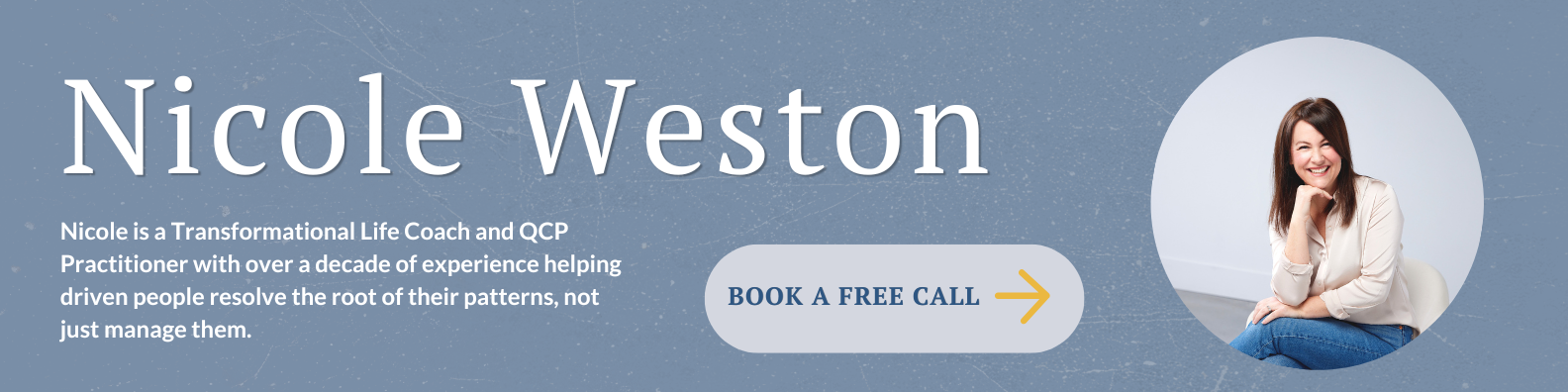
My name is Nicole Weston. I'm a transformational life coach, trained social worker, and host of theCan't Call Your Mom podcast. I've spent over 14 years helping women do deep soul-level healing work. And when my mom, Lisa, died suddenly on May 3th, 2021, at 57 years old — I fell apart in ways I never saw coming.
This is what I shared in one of the most vulnerable episodes of this podcast. Not from behind my coaching hat. But as a motherless daughter, a motherless mother, and a woman who had to completely rebuild who she was.
The Life I Was Living When She Died
Four days before my mom died, I paid one of the largest tax bills of my life — because I had just completed one of the most successful years in my business. My husband and I were newly engaged. My daughter Hannah was about to turn three. I was living what I had put on my vision board years before.
I was at the peak. Truly aligned. Doing the work I was born to do.
And then Monday morning came. A strange tone on my phone. A Facebook message from her partner: "Nicole, call me. There's an emergency."
When I called back, his voice was low and shaking.
"Nicole, your mom is dead."
I rejected the idea entirely. I told him to call 911. He told me they were already there.
I drove to her home in shock, not fully understanding how I got there. The coroner met me on the driveway and confirmed what I could not accept.
That was the moment everything I knew about myself — my strength, my resilience, my capacity — cracked open.
The Identity Collapse No One Talks About
As a life coach who had spent years doing mental, emotional, spiritual, and somatic healing work, I believed I had the tools to navigate this. I told myself I could hold my grief while still showing up as a mother, a business owner, a wife.
For the first six months, I almost believed it.
But grief doesn't follow the plan you make for it.
Around six months after my mom died, we received more information about how she actually passed. That news changed the texture of my grief entirely. What had been shock and sadness deepened into something darker — shame, rage, and a belief that I had failed her. That somehow my soul contract with her had been to save her life, and I hadn't.
That shame drove me inward. Month by month, belief by belief, everything I had built my identity on started to crumble.
I had believed everything happens for a reason. I had believed in the law of attraction, in alignment, in co-creation with the universe. And then I didn't. I couldn't. Because I couldn't make my mother's death mean anything good, and when I couldn't find the meaning, I felt like I was losing myself.
My intuition — which had been a ten out of ten — went silent. I turned it off. I said, "Don't come near me. Don't show me signs. Don't try me."
My business started to decline. The momentum I'd built over years slowed. I knew cognitively that grief was doing this, but the voice inside my head said: You should be able to figure this out. You're a life coach. What is wrong with you?
That question — what is wrong with me? — is one of the most damaging things we can ask ourselves in grief. And it's one of the most common.
The Complicated Truth About My Mom
I want to be honest about something that I don't think gets talked about enough in conversations about motherless mothers: not all mother-daughter relationships are uncomplicated.
My mom and I loved each other deeply. She was vibrant, fierce, and an incredible advocate. She was a nurturing, thoughtful mother who made sure my brother and I never went without. She recorded every Christmas morning. She showed up.
She also struggled. Her own unresolved grief, her own trauma, her own demons — they showed up in ways that created complexity in our relationship for many years. She coped with alcohol. We went through an estrangement. We had parentification and role reversal that took years of deep work to untangle.
But here is what I know now, five years later: she and I also did the work. We healed layers of our relationship. We established boundaries — something neither of us knew how to do before. By the time she died, we were in the most whole, healthy place we had ever been. She was doing sleepovers with Hannah. She had a new doctor. She was taking care of herself in ways she never had before.
We were at the peak of something beautiful — and it ended.
That grief is layered in ways that are hard to explain. You can love someone deeply, have a complicated history with them, and still be absolutely shattered by their death. Those things are not contradictory. They are both true.
What Grief Did to the Motherless Mother in Me
When you are a motherless mother — meaning you are actively mothering your own children while grieving the loss of yours — the grief becomes something else entirely.
You are trying to hold your daughter's question about why Nanny didn't bring her phone with her when she died. You are trying to be present at birthday parties while a part of you is still standing on that driveway. You are watching your child grow through milestones your mom was supposed to witness. You are becoming a mother without the mother who showed you how.
And you are doing all of this while running a business, managing a household, trying to be present in your marriage, and attempting — desperately — not to fall apart.
For me, the anger came. Fierce, rageful, surprising anger. I would walk past a picture of my mom and say, out loud, "Fuck you." I was angry she had died. Angry that I hadn't gotten to say goodbye. Angry that she had taken so much with her — so many future moments, so many things I would never get to tell her.
And I was angry at myself for being angry.
That is the double bind of grief no one prepares you for: you grieve the person, and then you grieve yourself for how you are grieving. The shame of not doing it "right." The judgment of not being healed fast enough. The belief that because you have done talking about it you should be able to move on. But, I needed the integration of mind and body.
The Moment Everything Began to Shift
In August 2024 — three years into this journey — I did a deep Quantum Change Process session. And in that session, something happened that I can only describe as integration.
It was as if the woman I was before my mom died, and the woman I had become after, finally came home to each other.
My nervous system, which had been in fight-or-flight for years, settled. My logical mind and my emotional body stopped fighting and started working together. All the parts of me that had been living separately — the grieving daughter, the ambitious coach, the mother trying to hold it together, the woman who had lost her spark — they integrated.
For the first time in years, I could hear myself again.
I could hear all the parts of me, and they were all welcome.
That is what integration feels like. Not the absence of grief. Not being "over it." But a wholeness — a capacity to hold the loss and the love, the sadness and the ambition, the grief and the joy, all at the same time, without one erasing the other.

I could hear all the parts of me, and they were all welcome.
That is what integration feels like. Not the absence of grief. Not being "over it." But a wholeness — a capacity to hold the loss and the love, the sadness and the ambition, the grief and the joy, all at the same time, without one erasing the other.
What I Know Now About Grief and Identity Transformation
Five years in, here is what I would tell every motherless mother who is in the middle of this:
Your emotions are not your identity. They are indicating what you need. When you feel the rage, it is not telling you that you are a bad person or a bad daughter. It is telling you that something sacred has been violated — your mother's presence in your life — and your body is responding accordingly.
Grief is a physical experience. It lives in your nervous system, your cellular memory, your body. Talk therapy alone is not enough. You need somatic work. You need to move the emotions through. Screaming into a pillow. Moving your body. Writing the letters you never got to send. These are not soft suggestions. They are non-negotiables.
The identity you had before is not coming back. And that is not a failure. That is the invitation. Grief is asking you to become a more whole, more integrated version of yourself. Not the same woman you were before — a more expanded one.
You are not doing it wrong. If you are still grieving at year two, year three, year five, you are not doing it wrong. There is no timeline. There is only the movement of love finding its way through you.
The anger is protecting you. For me, anger was the fuel that kept me moving when sadness would have kept me in bed. Give yourself permission to be angry. Find a safe container for it. And know that on the other side of the anger, when you have moved it fully through your body, what is waiting is love.
Why I Started Can't Call Your Mom
I started this podcast because I could not find what I needed.
I looked for spaces where I could bring all of me — the grieving daughter, the ambitious entrepreneur, the mother raising her children without her own mother, the woman who was healing and struggling and growing all at the same time. I couldn't find it.
So I built it.
Can't Call Your Mom is not a grief support group. It is not a business podcast. It is not a parenting show. It is a space for the whole woman. For the woman who holds all of it — and finally has somewhere to set it down.
Every episode, we sit with women who are living, loving, and leading after losing their moms. We don't make grief pretty. We don't rush toward silver linings. We sit in it. We move through it. We share the things that nobody says out loud — the anger, the darkness, the guilt of still being ambitious, the loneliness of being the strong one.
And we come back, always, to love.
Because grief is love with nowhere to go. And this podcast — this community — is where that love has somewhere to land.
The Question That Started It All
A few months after my mom died, I was putting Hannah to bed. We were reading a book, singing our songs. And in the middle of the book, she stopped, looked at me, and asked:
"Mom, why didn't Nanny just bring her phone with her when she died?"
She was almost three years old.
I was frozen. Pure sadness and pure joy at the same time — shattered by the question, and in awe of my daughter's love and curiosity and grief.
At that moment, there were three of us grieving. The mother I am. The inner child I am. And my daughter, who had lost her Nanny.
All three of us are trying to figure out where to put the love.
Can't Call Your Mom was born at that moment. As a ritual. A practice. A co-creation between my daughter, myself, and my mom — who I believe is here, in this community, in every conversation we have.
You Are Not Alone in This
If you are a motherless mother — if you are raising children while carrying this grief, if you are running a business while barely recognizing yourself, if you are searching for a place that holds all of who you are — you have found it.
This is your community. This is your movement.
You don't have to choose between healing and ambition. You don't have to grieve quietly. You don't have to figure this out alone.
Your mom died. That pain is real and indescribable. And you are still here. Still mothering. Still building. Still becoming.
That is not weakness. That is the most profound expression of what it means to be human.
Nicole Weston is a transformational life coach, trained social worker, Quantum Change Process™ practitioner, and host of the Can't Call Your Mom podcast. She supports women navigating grief, motherhood, and major life transitions — helping them cultivate emotional resilience, restore confidence, and lead without losing themselves.
New episodes drop every week.
Subscribe and join the community at nicoleweston.ca
Book a free connection call: https://nicoleweston.as.me/introductorycall
Find Nicole on Instagram: @thenicoleweston
Related Episodes: